Eco-Friendly Perfume Brands: What Genuine Sustainability Looks Like in Luxury Fragrance
Walk into almost any beauty aisle today and you will find the words “eco-friendly,” “clean,” and “sustainable” stamped across nearly everything — often on products with no meaningful difference from what sat on those same shelves a decade ago. Fragrance is no exception, and arguably worse: because perfume formulas are legally protected as trade secrets, brands can attach the label “eco-friendly perfume” to almost anything with very little accountability. So when a search for eco-friendly perfume brands returns hundreds of results, how do you find the handful making genuine change? The answer lies less in marketing copy and more in what happens after the bottle is empty.
Why “Eco-Friendly” Has Become the Most Abused Word in Beauty
Fragrance sits in a strange regulatory blind spot. Under most cosmetic labelling laws, a perfume's exact composition can be listed simply as “parfum” or “fragrance” — a single word standing in for what might be forty or fifty individual ingredients. This protects proprietary formulas, but it also means a brand can quietly use synthetic musks, petrochemical-derived fixatives, or unsustainably harvested woods while the label says nothing more specific than “fragrance.”
Layer onto that the fact that “natural,” “clean,” and “eco-friendly” are not legally defined terms in most markets, and you have the perfect conditions for greenwashing. A brand can switch to a recycled cardboard box, keep everything else identical, and market itself as having gone green. It is a low-effort claim that costs almost nothing to make — which is exactly why it has become so common.
Genuine sustainability in perfumery looks entirely different. It is structural, not cosmetic. It shows up in how a bottle is designed to be used for years rather than discarded after one, in where the raw materials actually come from, and in whether a brand is willing to be transparent about the parts of the process that are still imperfect.
What Genuinely Eco-Friendly Perfume Brands Actually Do Differently
They design for refill, not replacement. This is the single clearest signal. A fragrance house serious about sustainability engineers its bottles to be refillable by design — not as an afterthought accessory, but as the core product architecture. The crystal, the cap, the stand become a permanent object you own for years, while only the fragrance itself is replenished. Compare this to the standard model, where a beautifully designed bottle is manufactured, used once, and thrown away — a genuinely wasteful use of glass, metal, and craftsmanship for a single use cycle.
They can trace their ingredients. Ask a genuinely sustainable perfume house where its oud, its amber, its rose absolute comes from, and you should get a real answer — a region, a supplier relationship, a harvesting practice — not a shrug. Traceable, naturally derived ingredients cost more to source and formulate with than synthetic shortcuts, which is precisely why brands that invest in them tend to talk about it specifically, rather than in vague, feel-good language.
They choose materials that last. Crystal, glass, and metal are heavier and more expensive to produce than plastic — but they do not leach, they do not degrade in sunlight, and they can be refilled indefinitely. A brand that has genuinely prioritised sustainability will accept the higher production cost of durable materials over the cheaper, disposable alternative.
They are transparent about production scale. Small-batch formulation, made to order rather than mass-produced and warehoused, reduces waste from unsold stock — one of the beauty industry's least discussed environmental problems. Brands doing this well tend to mention batch sizes, production timelines, and formulation practices openly, rather than burying the subject.
Five Signs You Are Looking at Greenwashing, Not Sustainability
- Vague claims with no specifics. “Eco-conscious,” “nature-inspired,” or “mindfully made” with nothing to back it up.
- Recyclable packaging, but no refill option. Recycling is a last resort, not a sustainability strategy — reuse always outperforms it.
- No ingredient transparency. If a brand cannot tell you where a key note comes from, it likely does not know either.
- “Natural-inspired” fragrance notes. Language that implies natural origin for what is, in reality, a synthetic recreation.
- A single green product in an otherwise unchanged range. One “eco” limited edition surrounded by a catalogue that has not changed its practices at all.
The Refill Revolution: Why It Is the Clearest Proof of Commitment
If you take one filter away from this guide, make it this: ask whether the brand offers a refill. Refillable perfume is not a passing trend — it is the fragrance industry's most direct answer to the single-use packaging problem. A single beautifully engineered vial, refilled year after year, eliminates the repeated production of glass, caps, boxes, and shipping materials that a disposable bottle demands every time you finish a fragrance.
It also changes the relationship between wearer and object. A refillable vial is not consumed and discarded — it becomes something closer to fine jewellery: a permanent possession that develops meaning over time, refilled rather than replaced, carried rather than binned.
The Potion Paris Approach to Sustainable Luxury
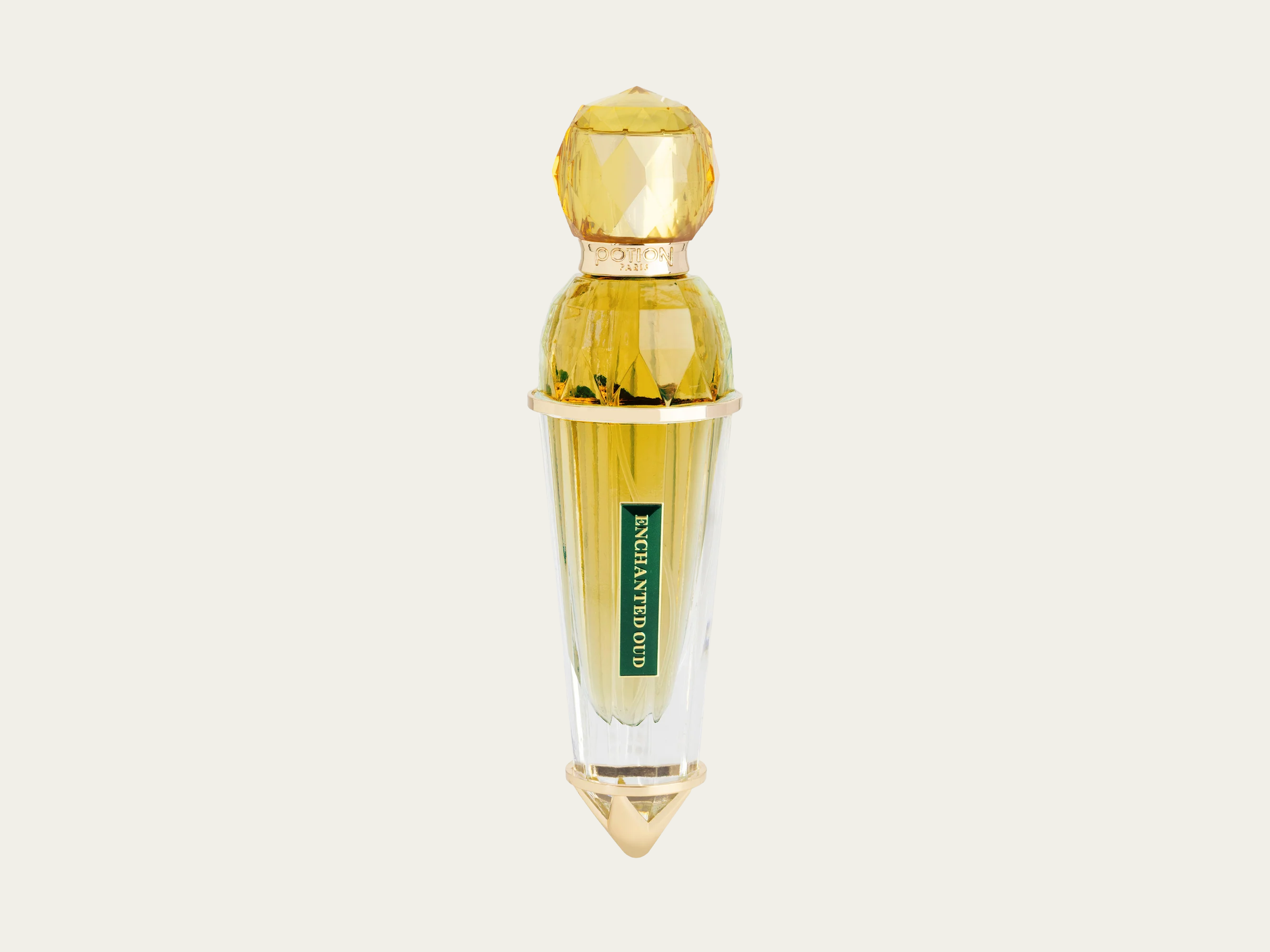
This is precisely the philosophy behind Maison Potion Paris. The Crystal Vial — a 50ml refillable bottle with a crystal cap and gold stand, presented in storybook packaging — was designed from the outset to be refilled, not replaced. Choose a fragrance like Enchanted Oud for its warm, resinous depth, Rose de Nuit for its dark, velvety florals, or Royal Amber for its golden, sensual warmth — and the vessel itself remains part of your collection for years, ready to be refilled again and again.
For those who want their fragrance to travel with them, the Potion Pendant extends the same principle into a wearable form: a portable, refillable 3ml capsule designed as a genuine luxury accessory rather than a disposable travel spray. It is sustainable luxury in the truest sense — conscious of its footprint without ever compromising on craftsmanship, from the mysterious depth of Noir de Marrakesh to the exotic gold-and-spice character of Zahara.
This is what separates a genuinely eco-friendly perfume brand from one simply borrowing the language: the sustainability is built into the product's architecture, not printed on a sticker.
Frequently Asked Questions
What actually makes a perfume brand eco-friendly?
A genuinely eco-friendly perfume brand is defined by structural choices, not marketing language: refillable bottle systems designed for years of reuse, traceable and responsibly sourced ingredients, durable materials like glass, crystal, and metal instead of plastic, and transparency about where notes come from and how the fragrance is produced. Recyclable packaging alone does not qualify — reuse and refill are the stronger indicators.
Are eco-friendly perfume brands as luxurious as traditional fragrance houses?
Yes — and increasingly, the most sustainable luxury fragrance houses are setting the standard for craftsmanship rather than trailing behind it. Refillable crystal vessels, hand-finished caps, and considered packaging can be more luxurious than single-use bottles, precisely because they are built to be kept, displayed, and used for years rather than discarded after one cycle.
How can I tell if a fragrance brand is greenwashing rather than genuinely sustainable?
Look past the packaging language and ask three questions: Does the brand offer a refill, or only recycling? Can it name where key ingredients are sourced? And has the sustainability commitment changed the actual product — the bottle, the formulation, the production scale — rather than just the marketing copy around it? If the answer to any of these is vague, the claim is likely more marketing than practice.
Sustainability in fragrance was never going to be solved by a recycling symbol on a box. It required rethinking the bottle itself — designing something worth keeping, refilling, and carrying for years, rather than something built to be thrown away. Discover the Potion Paris collection and experience what luxury looks like when it is built to last.