What Does Oud Smell Like? The Complete Guide to the World's Most Coveted Scent
The Short Answer
Oud smells like nothing else on Earth. It is woody, smoky, slightly sweet, sometimes animalic, and always deep. But that description barely scratches the surface — because oud is not one scent. It is an entire spectrum, as varied as wine, and just as influenced by terroir, age, and craftsmanship.
If you have never smelled real oud, imagine standing in an ancient forest after rainfall: damp earth, warm resin, wisps of incense smoke, and something alive and slightly wild underneath it all. That is the ballpark. But the truth is more complex and more fascinating.
What Is Oud, Exactly?
Oud — also known as agarwood, aloeswood, or oud al hindi — is a dark, aromatic resin produced by Aquilaria trees when they become infected with a specific type of mould (Phialophora parasitica). The tree produces this resin as a defence mechanism, saturating its heartwood with fragrant oils over years or even decades.
Only an estimated 2% of Aquilaria trees in the wild develop this infection naturally. This rarity, combined with the time required for high-quality resin to form, is why oud is often called "liquid gold" — premium agarwood oil can cost between £30,000 and £75,000 per kilogram, making it one of the most expensive natural raw materials on the planet.
Oud has been prized for over 3,000 years. It is mentioned in ancient Sanskrit texts, burned as sacred incense in Japanese kōdō ceremonies, and remains central to fragrance culture across the Middle East and Southeast Asia. Its journey into Western perfumery is relatively recent — largely beginning in the early 2000s — but it has since become one of the most sought-after notes in luxury fragrance.
The Different Faces of Oud
One of the most common misconceptions about oud is that it has a single, fixed scent. In reality, oud varies dramatically based on where the tree grew, how long the resin developed, and how the oil was extracted. Here is how the major varieties differ:
Indian Oud (Hindi)
The most intense and polarising variety. Indian oud is deep, animalic, and sometimes described as "barnyard-like" in its raw form — a quality that is cherished by traditionalists and oud purists. When aged or distilled well, it develops extraordinary depth: leathery, slightly medicinal, with a smoky sweetness that can last for days on clothing. This is the oud that Middle Eastern royalty has prized for centuries.
Smells like: Dark leather, aged wood, animal musk, medicinal herbs, sweet smoke
Cambodian Oud (Khmer)
Sweeter and more approachable than Indian oud. Cambodian varieties tend to have a honeyed, fruity quality — sometimes compared to overripe tropical fruit or dried apricots. The animalic edge is softer, making this the variety most newcomers find immediately appealing.
Smells like: Honey, dried fruit, warm wood, gentle smoke, caramel
Indonesian Oud
Earthy and grassy, with a drier character than Cambodian or Indian varieties. Indonesian oud often has a distinctive tobacco-like quality and a green, herbal undertone. It is frequently used in traditional incense and is valued for its grounding, meditative quality.
Smells like: Dry tobacco, fresh earth, green herbs, wood shavings, warm hay
Thai Oud
Often considered the most refined and elegant variety. Thai oud is creamy, smooth, and sometimes described as "buttery" with floral undertones — particularly a subtle violet-like sweetness. It is less aggressive than Indian oud but carries remarkable depth and longevity.
Smells like: Cream, butter, soft flowers, polished wood, subtle violet
Malaysian Oud
A middle ground between the intensity of Indian oud and the sweetness of Cambodian. Malaysian oud tends to be fruity and slightly spicy, with a well-balanced profile that makes it popular in both traditional oil form and modern perfumery.
Smells like: Dark fruit, warm spice, aromatic wood, light sweetness
Real Oud vs Synthetic Oud: Can You Tell the Difference?
Here is the uncomfortable truth that the fragrance industry rarely discusses openly: the vast majority of "oud" perfumes on the market contain no real oud whatsoever.
Synthetic oud accords — created using molecules like Javanol, Iso E Super, Cashmeran, or Georgywood — are used to approximate oud's character at a fraction of the cost. These molecules are not inherently bad. Some are beautifully crafted and produce appealing results. But they are fundamentally different from the real thing.
How to tell the difference:
- Evolution on skin: Real oud changes dramatically over hours — you will notice distinct phases as different facets emerge. Synthetic oud tends to remain relatively static.
- Depth and complexity: Genuine oud has a three-dimensional quality, almost a texture to the scent. Synthetic approximations tend to feel flatter, more one-note.
- The dry down: This is where synthetics reveal themselves most clearly. After 2-3 hours, synthetic oud often fades to a generic woody base. Real oud becomes more interesting over time — revealing creamy, balsamic, or honeyed facets in its final stages.
- Price point: A realistic indicator. If a 50ml "oud" perfume costs under £50, it almost certainly uses synthetic oud. The raw material alone makes genuine oud compositions inherently expensive.
- Ingredient disclosure: Brands that use genuine oud are typically proud to say so. Look for mentions of natural agarwood oil, natural Orpur oils, or specific oud origins. Silence on ingredients often means synthetic.
Oud in Modern Perfumery
In skilled hands, oud is not used as a standalone note but as a foundation — a deep, complex base upon which an entire fragrance narrative is built. The best oud compositions pair it with complementary notes that reveal different facets of its character:
- Oud + Rose: The classic Middle Eastern pairing. Rose's bright, romantic sweetness balances oud's smoky depth. This is the combination that introduced most Western noses to oud, and it remains one of the most beloved.
- Oud + Saffron: A golden, luxurious combination. Saffron's metallic warmth amplifies oud's richness, creating something that feels ancient and precious.
- Oud + Amber: Warm, enveloping, and deeply sensual. Amber softens oud's edges and extends its longevity, creating a comfort scent with serious depth.
- Oud + Leather: Bold and daring. Leather emphasises oud's animalic qualities, creating fragrances that feel powerful and commanding.
- Oud + Vanilla: A modern favourite. Vanilla's creamy sweetness makes oud incredibly approachable, resulting in compositions that are both deep and universally appealing.
Enchanted Oud by Potion Paris
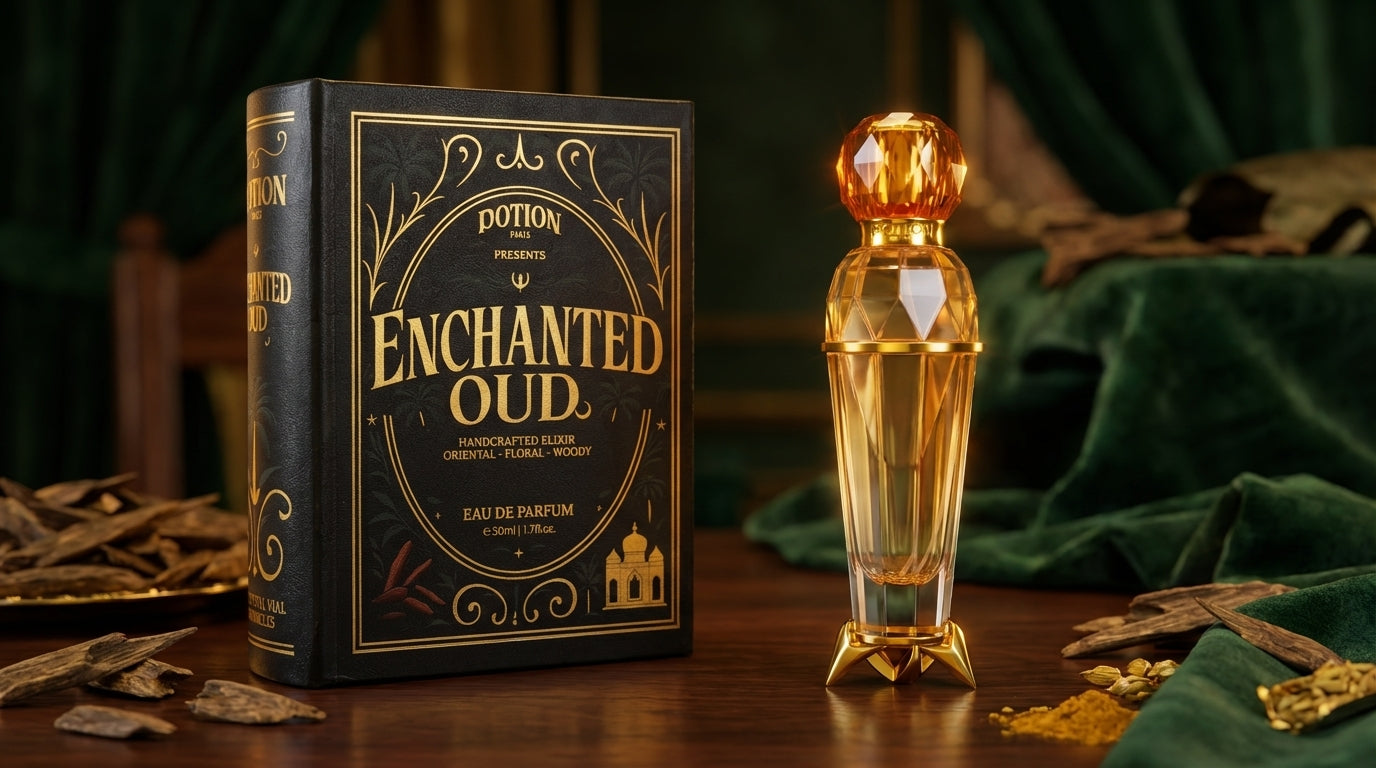
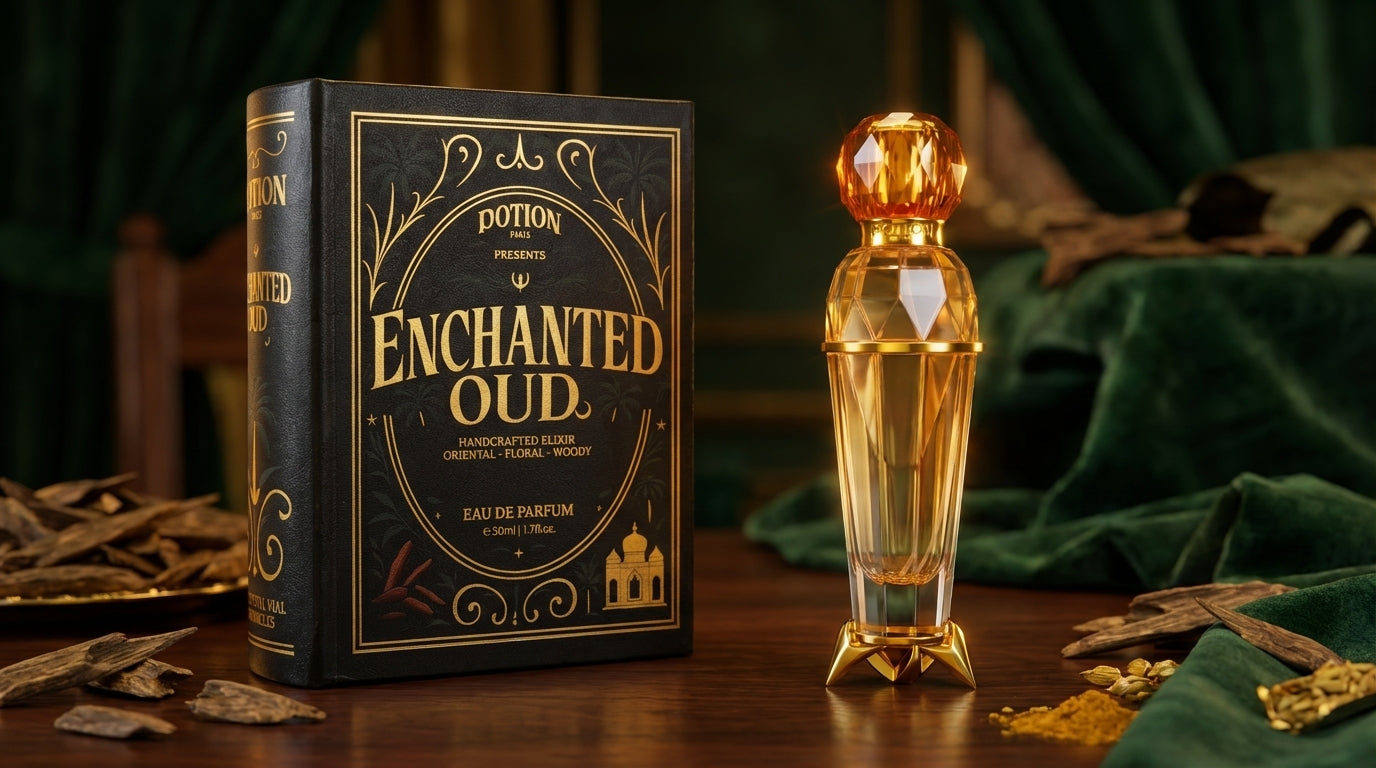
A masterful example of modern oud composition. Rather than presenting oud in its raw intensity, Enchanted Oud surrounds it with tart raspberry, Rose Damas, and jasmine, with a base of amber and sandalwood. Enhanced with natural Orpur oils, it delivers the authenticity and depth of genuine oud while remaining accessible enough for those new to the note. It is the fragrance equivalent of a guided tour through oud's possibilities.
Noir de Marrakesh by Potion Paris
Takes oud's smoky, resinous spirit in a different direction entirely — pairing it with leather, tobacco, and saffron to evoke the midnight souks of Marrakesh. While technically oud-adjacent rather than oud-forward, it captures the essence of what draws people to oud: mystery, depth, and a sense of the sacred. Currently nominated for multiple fragrance awards.
How to Experience Oud for the First Time
Start with blended compositions, not pure oud oil
Pure oud oil is intense and can be overwhelming for uninitiated noses. A blended perfume — where oud is one note among many — is a far better introduction. Compositions that pair oud with rose, amber, or vanilla are particularly accessible.
Apply sparingly
Oud is powerful. One to two sprays is sufficient for your first experience. Apply to pulse points (wrists, neck) and give the fragrance time to develop — oud reveals itself gradually over 30-60 minutes.
Reserve judgement
Many people who now love oud had mixed feelings on first encounter. The initial impression can be challenging — smoky, intense, unusual. Give it time. Oud is an acquired taste, but once acquired, it becomes almost impossible to give up.
Try multiple varieties
Do not base your opinion of oud on a single fragrance. The difference between an Indian oud composition and a Cambodian-inspired one is enormous. If you dislike one style, another may captivate you entirely.
Frequently Asked Questions
Is oud a masculine scent?
No. The gendering of fragrance is a modern Western marketing invention. In the Middle East and Asia, where oud has been worn for millennia, it has always been used by both men and women. Many of the finest oud compositions — including those by Potion Paris, MFK, and Byredo — are designed as unisex fragrances.
Why does oud smell different on different people?
Your skin's pH level, natural oils, diet, and even the bacteria on your skin all influence how a fragrance develops. Oud is particularly responsive to body chemistry because of its complexity — different chemical compounds in the oil interact with your skin's unique profile, creating a scent that is subtly different on every wearer. This is one of the reasons oud enthusiasts are so passionate about it: it becomes genuinely personal.
Does oud smell bad?
Raw, unaged Indian oud can smell challenging to Western noses — sometimes described as "medicinal" or "barnyard-like." But in well-composed perfumes, these rough edges are refined and balanced with complementary notes. The result is deep, complex, and beautiful rather than off-putting. If you have tried an oud fragrance and found it unpleasant, you likely encountered either a low-quality synthetic approximation or an overly raw composition.
How long does oud last on skin?
Quality oud fragrances typically last 8-12 hours on skin, with some exceptional compositions lasting up to 24 hours. The sillage (projection) tends to be strongest for the first 3-4 hours before settling into an intimate skin scent. On clothing, oud can linger for days.
Is oud sustainable?
Wild Aquilaria trees are endangered, and wild-harvested oud raises legitimate sustainability concerns. However, responsible producers now cultivate Aquilaria trees in plantations and use inoculation techniques to produce agarwood without depleting wild populations. Reputable fragrance houses source their oud from sustainable plantation operations. When buying oud products, look for brands that are transparent about their sourcing practices.