Why Expensive Perfume Smells Different: The Truth About Fragrance Quality
You Are Not Imagining It
You have probably noticed that an £8 body spray and a £200 eau de parfum do not just smell different — they behave differently. One fades within an hour. The other evolves on your skin for eight, ten, twelve hours, revealing different facets as the day progresses. One smells the same on everyone. The other becomes distinctly yours.
This is not marketing. It is chemistry. And understanding the difference between cheap and expensive perfume will change how you think about fragrance forever.
Concentration: The First and Most Obvious Difference
Fragrances are classified by the concentration of aromatic compounds (perfume oils) dissolved in alcohol:
- Eau Fraîche: 1-3% — barely there, lasts 1-2 hours
- Eau de Cologne (EdC): 2-5% — light, refreshing, 2-3 hours
- Eau de Toilette (EdT): 5-15% — the standard for mass-market, 3-5 hours
- Eau de Parfum (EdP): 15-20% — richer, longer-lasting, 6-10 hours
- Parfum / Extrait: 20-40% — the purest form, 10-24 hours
Most inexpensive fragrances are Eau de Toilette or lower. Most luxury fragrances are Eau de Parfum or Extrait. This difference in concentration alone accounts for a significant portion of the price gap — more perfume oil means more cost, but also dramatically better performance.
However, concentration is only part of the story. The quality of those oils matters far more.
Natural vs Synthetic: The Ingredients That Define Quality
The fragrance industry uses two categories of ingredients: natural extractions (essential oils, absolutes, tinctures) and synthetic molecules (aroma chemicals created in laboratories). Both have legitimate roles in perfumery. But the balance between them is what separates exceptional fragrances from ordinary ones.
Natural Ingredients
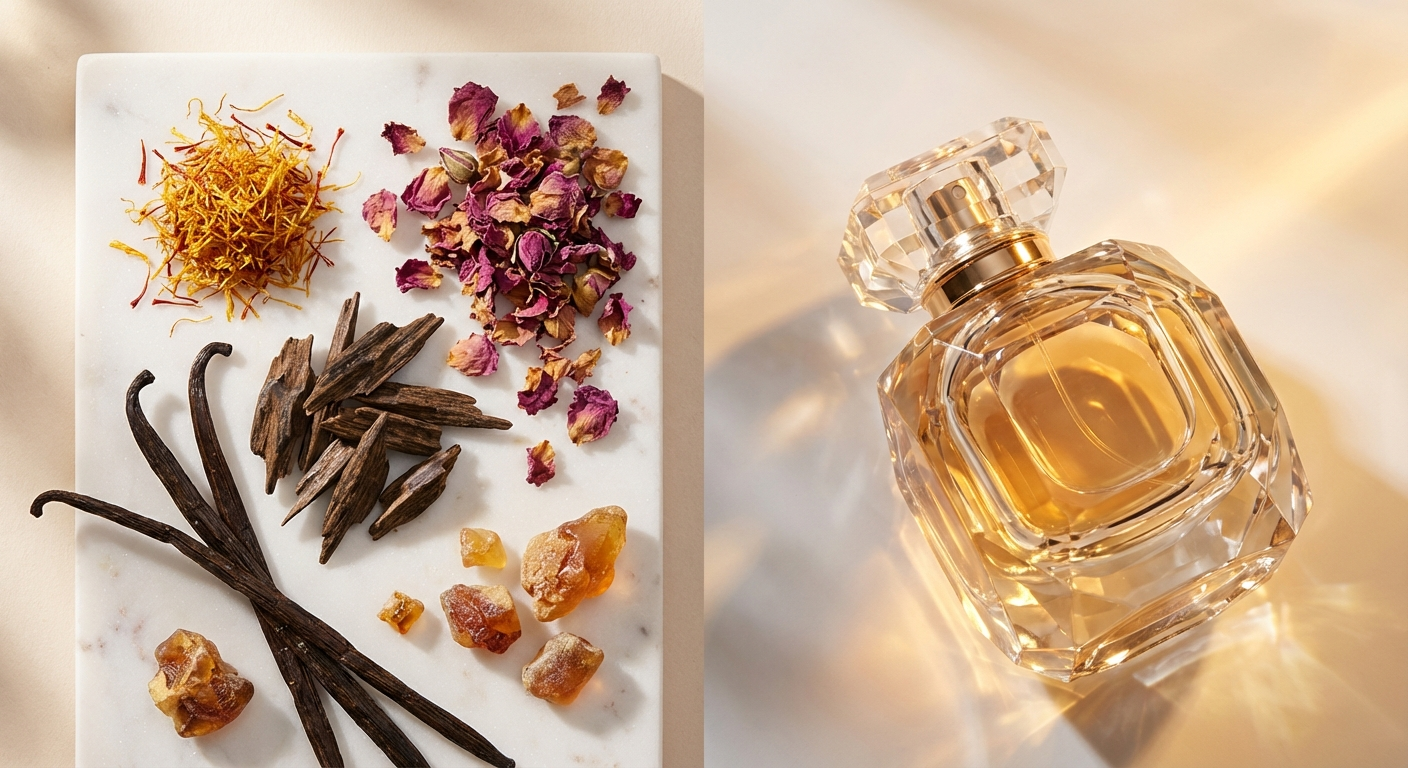
These are extracted directly from natural sources — flowers, woods, resins, spices, fruits. They are complex by nature, containing hundreds of individual chemical compounds that interact with each other and with your skin chemistry. This complexity is what creates the sense of depth and evolution in a fine fragrance.
Examples and costs:
- Oud (agarwood oil): £30,000-£75,000/kg — the most expensive, from infected Aquilaria trees
- Rose absolute (Rosa damascena): £5,000-£12,000/kg — requires approximately 10,000 roses to produce 5ml of oil
- Orris butter (iris root): £40,000-£100,000/kg — iris roots must be dried for 3-5 years before distillation
- Saffron absolute: £3,000-£5,000/kg — the world's most expensive spice, even more costly as an absolute
- Sandalwood oil (Mysore): £2,000-£4,000/kg — from trees that must grow for 30+ years before harvesting
- Jasmine absolute: £3,000-£8,000/kg — approximately 8,000 flowers to produce 1ml of absolute
When a luxury perfume house uses genuine rose absolute, real oud, or natural sandalwood, these costs are reflected in the retail price. There is no shortcut.
Synthetic Molecules
Created in laboratories to replicate or approximate natural scents. Some — like Iso E Super, Hedione, or Calone — are masterful creations that have genuinely expanded the perfumer's palette. They are consistent, affordable, and sometimes achieve effects that natural materials cannot.
However, synthetic molecules are inherently simpler than natural extractions. Where rose absolute contains over 400 individual compounds, a synthetic "rose" might contain 3-5 molecules blended to approximate the general character. It can smell pleasant, even beautiful — but it lacks the depth, the micro-variations, the life of the real thing.
The key difference: Natural ingredients interact with your body chemistry in subtle, personalised ways. Synthetic molecules tend to behave the same on everyone. This is why a luxury fragrance can smell slightly different on two different people — and why a budget fragrance smells identical on everyone who wears it.
The Art of Composition: Why Perfumers Matter
Ingredients alone do not make a great fragrance, any more than premium ingredients alone make a great meal. The composition — how those ingredients are combined, in what proportions, in what sequence — is where the artistry lives.
A master perfumer (or "nose") may spend months or years developing a single composition, working through hundreds of iterations to achieve a specific vision. The great houses — Hermès, Chanel, Maison Francis Kurkdjian — employ or commission perfumers who have trained for decades in the craft.
What they achieve that mass-market fragrance designers typically do not:
- Three-dimensional structure: Distinct top, heart, and base notes that reveal themselves in sequence, creating a fragrance that tells a story over time rather than delivering a single, static impression.
- Tension and balance: Great compositions create controlled contrast — sweetness against bitterness, warmth against freshness, darkness against light. These tensions are what make a fragrance interesting and memorable.
- The dry down: The final stage of a fragrance's evolution, often 4-8 hours after application. In cheap perfumes, the dry down is usually flat and uninteresting. In fine perfumery, it is often the most beautiful phase — the reward for patience.
- Sillage with subtlety: The ability to be noticed without overwhelming. A well-composed luxury fragrance projects enough to leave an impression but recedes gracefully, drawing people closer rather than pushing them away.
Why Presentation Is Not Just Marketing
There is a tendency to dismiss luxury packaging as superficial — a cynical mark-up on what is "just a bottle." But in fragrance, presentation serves a genuine psychological function.
Research in consumer psychology consistently shows that the ritual of applying fragrance — the weight of the bottle in your hand, the satisfying click of the cap, the visual beauty of the vessel on your dressing table — contributes meaningfully to the experience. It primes your brain for pleasure before the scent even reaches your nose.
This is not frivolous. It is the same principle that makes food taste better on beautiful plates, and wine taste better from proper glasses. Context shapes perception.
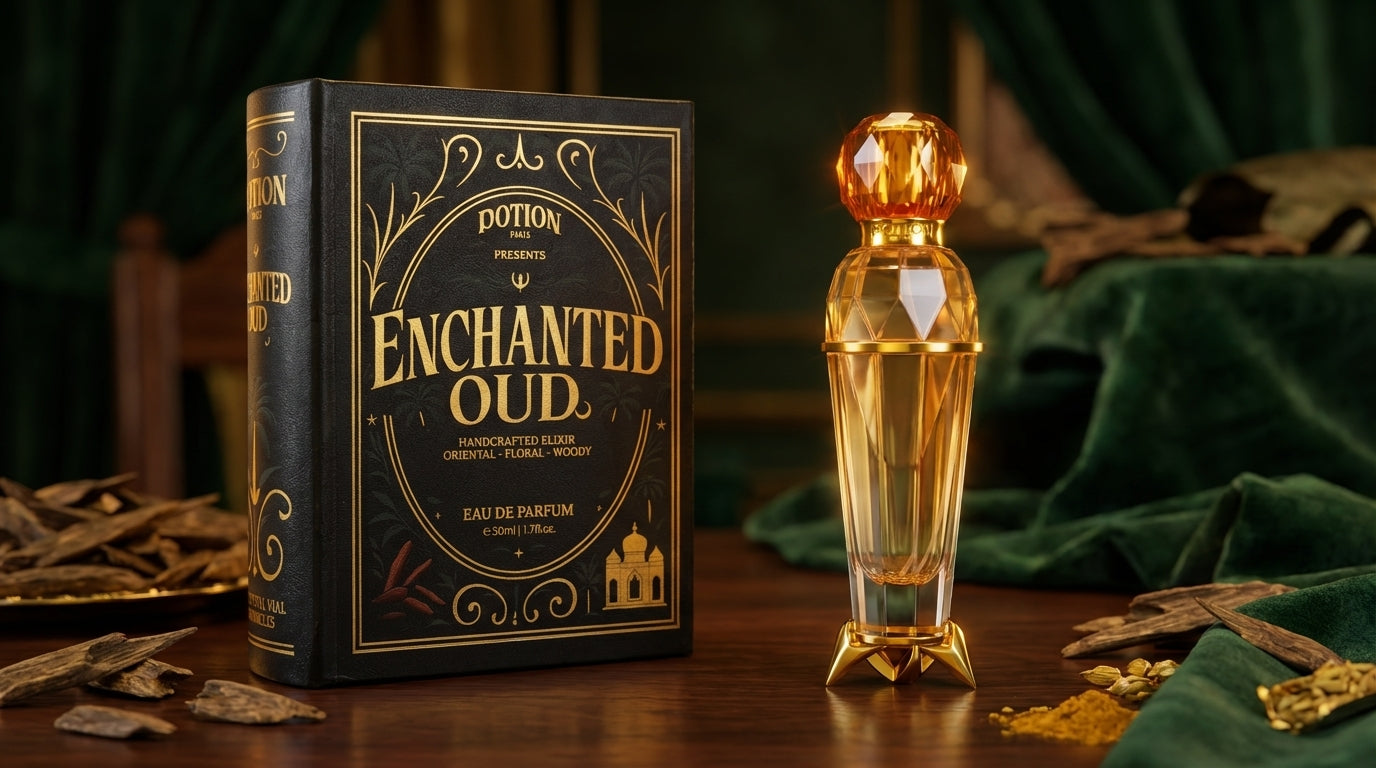
Brands that invest in presentation — Potion Paris's Crystal Vial with its faceted edges, gold stand, and accompanying storybook; Clive Christian's crown-capped bottles; MFK's precision-engineered sprayers — are not just charging for packaging. They are engineering a complete sensory experience that enhances the fragrance itself.
The Longevity Question: Why Cheap Perfume Fades
The most common complaint about inexpensive fragrances is that they disappear within hours. This is not a coincidence — it is a direct consequence of formulation:
- Lower oil concentration means fewer aromatic molecules on your skin, so the scent depletes faster.
- Simpler synthetic bases evaporate more quickly than complex natural oils, which cling to skin and evolve rather than simply dissipating.
- Lack of fixatives: Luxury fragrances use base notes like ambergris, musk, sandalwood, and benzoin that act as natural fixatives — anchoring the lighter top and heart notes and extending the overall lifespan of the composition. Budget fragrances often skip these expensive base materials.
- Alcohol quality: Even the alcohol base matters. Higher-grade ethanol evaporates more smoothly, depositing the fragrance oils evenly on the skin. Lower-quality alcohol can cause uneven evaporation and faster fade.
When a luxury fragrance lasts 10+ hours versus 2-3 hours for a budget alternative, the cost-per-wear calculation shifts dramatically. A £200 bottle that delivers 100+ wearings at 8 hours each costs £2 per use. A £20 bottle that requires reapplication every 2 hours may actually cost more per hour of wear.
What You Are Really Paying For
When you buy a luxury fragrance, your money goes towards:
- Raw materials — Natural oud, rose absolute, orris butter, sandalwood, and other precious ingredients that simply cost what they cost. There is no way to use real oud cheaply.
- Composition — The expertise of a trained perfumer who has spent decades learning their craft, and the months or years of development behind each formula.
- Concentration — Higher ratios of perfume oil to alcohol, meaning better performance, longer wear, and more nuanced development on skin.
- Presentation — Materials and design that create a complete sensory ritual, not just a container.
- Sustainability — Responsible sourcing of natural materials, refillable bottles, and ethical production practices that cost more than the disposable alternative.
What you are not paying for, in most cases, is the name on the bottle. The most overpriced fragrances in the industry are actually mid-range celebrity perfumes — where the brand name commands a premium while the juice inside is made with the cheapest available materials. At the true luxury end, the price-to-quality ratio is typically honest.
How to Tell If a Perfume Is Worth Its Price
- Spray it on skin, not paper. Paper strips reveal the top notes but nothing about how the fragrance develops with your body chemistry. Always test on your wrist and wait at least 30 minutes.
- Check the dry down. Come back to the fragrance after 4-6 hours. If it is still interesting and beautiful, the composition has genuine depth. If it has faded to nothing or become flat, the quality is not there.
- Look for natural ingredient claims. Brands proud of their materials will tell you. Mentions of natural Orpur oils, specific ingredient origins, or "absolute" (vs "accord") indicate genuine quality.
- Consider cost per wear. A £200 EDP lasting 8-10 hours over 100+ wearings costs less per hour than a £30 EDT lasting 2 hours. Longevity changes the value equation entirely.
- Trust your nose — but give it time. First impressions matter, but the best fragrances reveal their true character over hours, not seconds. Do not judge a complex composition on the first spray alone.
Frequently Asked Questions
Is expensive perfume always better than cheap perfume?
Not always — but usually. There are overpriced fragrances (mostly celebrity brands) and underpriced gems (some independent perfumers). However, the correlation between price and quality is stronger in fragrance than in most luxury categories, because the raw materials themselves have an irreducible cost. You genuinely cannot make a perfume with real oud, rose absolute, and orris butter for £30.
Why do some expensive perfumes still fade quickly?
Skin type matters. Dry skin absorbs and dissipates fragrance faster. Always moisturise before applying perfume. Additionally, some luxury fragrances are deliberately designed as "skin scents" — subtle, intimate compositions meant to be discovered close rather than projected widely. This is not a flaw; it is a design choice. Brands like Hermès are particularly known for this approach.
Are designer perfumes worth it compared to niche?
It depends on the brand. Some designer houses (Chanel, Dior, Hermès) produce fragrances of genuine quality at their higher price points. Others use the brand name to justify premium pricing on mass-market formulations. Niche houses — brands focused exclusively on fragrance — tend to invest a higher proportion of cost into the juice itself. Potion Paris, Le Labo, MFK, and Byredo are examples of niche brands where the quality-to-price ratio is typically excellent.
Can I tell if a perfume uses natural or synthetic ingredients?
Not always from the scent alone, though experienced noses can often tell. Look at the brand's transparency: do they discuss their ingredients and sourcing? Do they mention specific natural materials? Brands that use genuine natural oud, rose, or sandalwood are proud to say so. Silence on ingredients is usually a sign of a primarily synthetic composition.