



Oud vs Oudh: What's the Difference, and Why Does This Wood Cost More Than Gold?
Walk into any luxury department store fragrance section and you'll see "oud" everywhere. Oud perfumes from Tom Ford. Oud candles from Jo Malone. Oud everything from every brand that wants to signal luxury.
But what actually is oud? Why do some bottles spell it "oudh"? And why does genuine agarwood oil cost between £20,000 and £60,000 per kilogram — making it, gram for gram, more expensive than gold?
Oud and Oudh: The Same Thing
Let's clear this up immediately. Oud and oudh are the same thing. Different transliterations of the Arabic عود (ʿūd). Some brands use "oud" (more common in Western marketing), others use "oudh" (closer to Gulf Arabic pronunciation). You'll also see "aoud," "agarwood," and "aloeswood." All refer to the same material.
The wood comes from the Aquilaria tree, found across Southeast Asia — primarily Assam, Cambodia, Laos, Vietnam, and parts of Indonesia. When the tree is infected by a specific mould (Phialophora parasitica), it produces a dark, resinous heartwood as a defence mechanism. This infected wood is agarwood. The oil extracted from it is oud oil.
Here's the catch: only about 2% of Aquilaria trees develop the infection naturally. Finding an infected tree in the wild is genuinely rare, which is why wild-harvested oud commands extraordinary prices.
Why Oud Is So Expensive
Rarity
Wild Aquilaria trees are now critically endangered. CITES (Convention on International Trade in Endangered Species) has listed the entire genus since 2004. Legal wild harvesting is extremely limited, and most producing countries have export restrictions.
Time
The infection takes decades to produce high-quality resin. The best oud comes from trees that have been infected for 50-100+ years. You can't rush chemistry.
Yield
A mature infected tree might yield only a few kilograms of resinous wood. From that, steam distillation produces a few millilitres of pure oil. The economics are staggering — entire trees for drops of oil.
Grading
Not all oud is equal. Grading systems vary by region, but generally:
- Super/Double Super: The highest grade. Pure dark resin, minimal wood. Sinks in water. Reserved for direct burning in the Gulf or the most expensive perfumery.
- Grade A: Heavy resin content, dark colouration. Used in high-end perfumery and personal use.
- Grade B-C: Moderate resin. Common in commercial perfumery and incense production.
- Plantation oud: Farmed Aquilaria trees, often artificially inoculated. Lower resin complexity but more sustainable and affordable.
What Does Oud Actually Smell Like?
This is where it gets interesting, because oud doesn't smell like one thing. The scent profile varies dramatically based on origin:
- Cambodian oud: Sweet, fruity, almost jammy. Notes of dried fruit, honey, and vanilla. The most accessible to Western noses and the most prized in traditional Gulf perfumery.
- Indian oud (Assam): Animalic, barnyard, leathery. Can be genuinely challenging on first encounter — there's a reason people describe it as "faecal" or "horse stable." But this is considered the most complex and rewarding oud by connoisseurs. It mellows dramatically over hours.
- Vietnamese/Laotian oud: Woody, herbal, slightly medicinal. Often described as having a "green" quality. Less polarising than Indian oud.
- Indonesian oud: Earthy, mineral, sometimes smoky. Can have a distinctive "metallic" edge.
If your only reference point is a Tom Ford Oud Wood, you've experienced a very sanitised, Western-friendly interpretation. Real oud — especially high-grade Indian — is confrontational, evolving, and unlike anything else in perfumery.
Synthetic Oud vs Natural Oud
Here's what most brands won't tell you: the vast majority of "oud" perfumes contain no natural oud whatsoever.
Synthetic oud accords — typically built from molecules like Javanol, Iso E Super, Cashmeran, and Georgywood — can approximate aspects of oud's scent profile at a fraction of the cost. A kilogram of synthetic oud accord might cost £50-200. Natural oud oil? £20,000-60,000.
This isn't necessarily a criticism. Some synthetic oud compositions are beautifully crafted and more wearable than natural oud. But if you're paying £200+ for a perfume marketed as "pure oud" or "genuine oud," it's worth understanding what you're actually getting.
How to Tell
- Price point: If an "oud" perfume costs under £150 for 50ml, it almost certainly uses synthetic oud. The economics of natural oud don't allow for affordable retail pricing.
- Ingredient listing: Look for "Aquilaria" or "agarwood oil" in the ingredients. If it's not listed, it's not there.
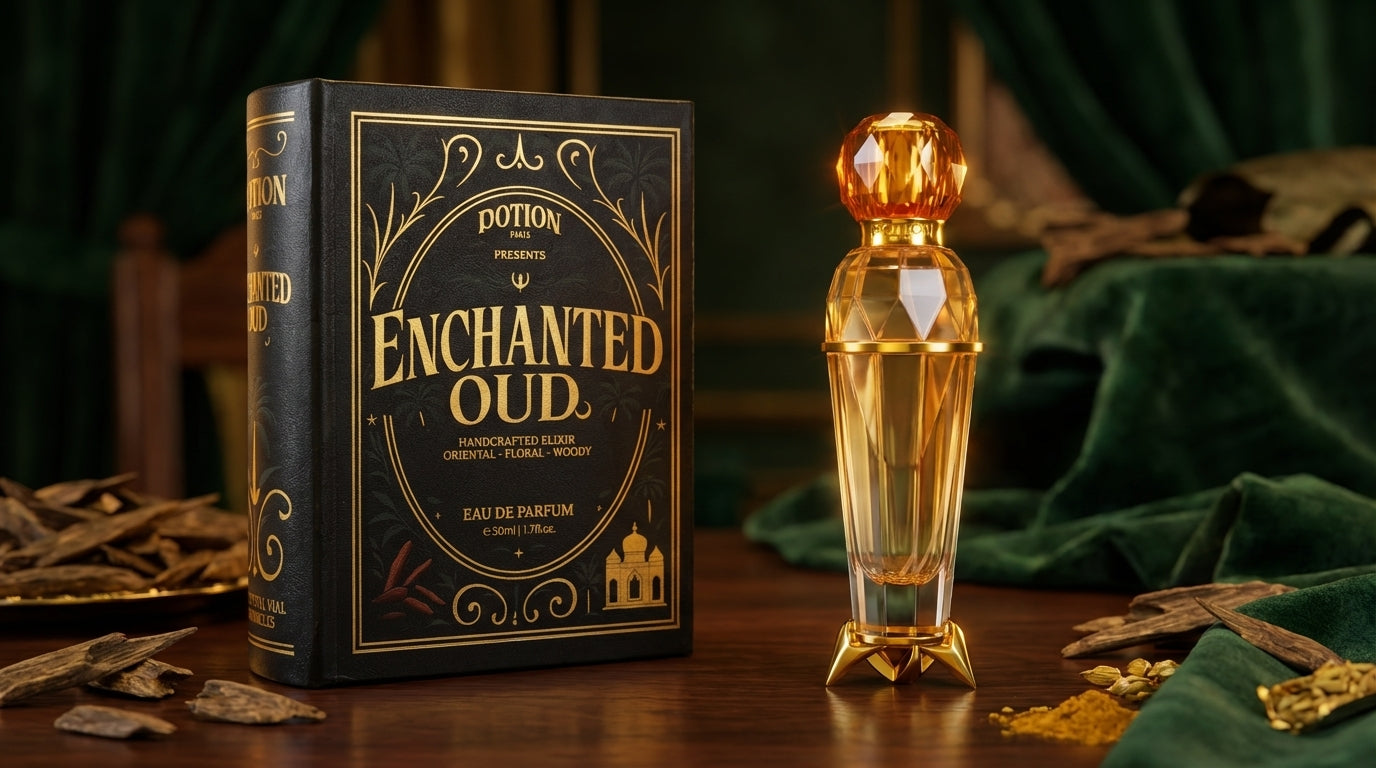
- Brand transparency: Houses like Potion Paris are transparent about their ingredient sourcing. Their Enchanted Oud builds its oud accord with carefully sourced ingredients, and the scent profile reflects genuine depth — the kind of evolving, hours-long development that marks quality oud composition. The woody, resinous base notes in their Crystal Vial format continue developing on skin for 10+ hours.
- Smell evolution: Natural oud changes dramatically over 4-8 hours. Synthetic oud tends to remain relatively static. If your "oud" perfume smells the same at hour 6 as it did at hour 1, it's synthetic.
Oud in Middle Eastern vs Western Perfumery
The cultural context matters enormously:
Gulf Tradition
In the Gulf states, oud isn't a "note" — it's the foundation of fragrance culture. Burning oud chips (bakhoor) to scent homes and clothes is a daily practice. Personal fragrance often involves layering: oud oil on pulse points, bakhoor on clothes, then a modern perfume on top. The result is complex, personal, and impossible to replicate with a single spray.
Gulf preferences lean towards intense, animalic Indian oud and sweet Cambodian oud. Subtlety isn't the goal — presence is.
Western Interpretation
Western perfumery discovered oud commercially in the mid-2000s, with Tom Ford's Oud Wood (2007) often credited as the breakthrough. Western oud fragrances typically:
- Use synthetic oud accords
- Soften the animalic edges with rose, vanilla, or amber
- Prioritise wearability over authenticity
- Market the exoticism rather than the actual material
Neither approach is "better" — they serve different purposes and different palates.
Best Oud Fragrances at Every Price Point
Entry Level (Under £100)
- Zara Oud — Surprisingly competent for the price. Won't fool anyone into thinking it's real oud, but pleasant.
- Al Haramain Amber Oud — Genuine Arabian house, excellent value, warm amber-oud combination.
Mid-Range (£100-250)
- Tom Ford Oud Wood — The gateway oud. Smooth, woody, inoffensive. Synthetic but well-constructed.
- Guerlain Oud Essentiel — More authentic than most Western ouds. Rose and oud in the French tradition.
- Potion Paris Enchanted Oud — A bridge between Eastern depth and Western wearability. The oud accord has genuine complexity without being confrontational, and the Crystal Vial presentation is extraordinary. Explore it here.
High-End (£250-500)
- Maison Francis Kurkdjian Oud Satin Mood — Oud with vanilla and Bulgarian rose. Luxurious and addictive.
- Kilian Paris Pure Oud — Closer to traditional Arabian oud than most Western offerings. Not for beginners.
Ultra-Luxury (£500+)
- Roja Dove Aoud — Contains genuine oud oil. One of the most expensive designer fragrances available.
- Amouage Interlude Man — Omani house, natural oud, incense, and oregano. Polarising and magnificent.
Is Oud Worth the Hype?
Yes and no. Real oud is genuinely one of the most extraordinary raw materials in perfumery — nothing else evolves, lingers, and provokes like it. If you get the opportunity to smell pure oud oil or high-grade bakhoor, take it. It's a sensory education.
But the "oud" label has been diluted by marketing. Not every oud perfume deserves the name, and paying a premium for synthetic oud in fancy packaging isn't always justified.
The test: does the fragrance make you feel something? Does it evolve on your skin over hours? Does it make people ask what you're wearing? If yes, the name on the bottle matters less than the experience on your skin.